


 Cart
Cart
 sales@molnova.com



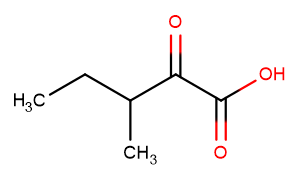
3-Methyl-2-oxovaleric acid
CAS No. 1460-34-0
3-Methyl-2-oxovaleric acid( —— )
Catalog No. M21412 CAS No. 1460-34-0
3-Methyl-2-oxovaleric acid is an abnormal metabolite that arises from the incomplete breakdown of branched-chain amino acids. 3-Methyl-2-oxovaleric acid is a neurotoxin an acidogen and a metabotoxin. A neurotoxin causes damage to nerve cells and nerve tissues.
Purity : >98% (HPLC)
 COA
Datasheet
HNMR
HPLC
MSDS
Handing Instructions
COA
Datasheet
HNMR
HPLC
MSDS
Handing Instructions
| Size | Price / USD | Stock | Quantity |
| 100MG | 59 | Get Quote |


|
| 200MG | Get Quote | Get Quote |
|
| 500MG | Get Quote | Get Quote |
|
| 1G | Get Quote | Get Quote |
|
Biological Information
-
Product Name3-Methyl-2-oxovaleric acid
-
NoteResearch use only, not for human use.
-
Brief Description3-Methyl-2-oxovaleric acid is an abnormal metabolite that arises from the incomplete breakdown of branched-chain amino acids. 3-Methyl-2-oxovaleric acid is a neurotoxin an acidogen and a metabotoxin. A neurotoxin causes damage to nerve cells and nerve tissues.
-
Description3-Methyl-2-oxovaleric acid is an abnormal metabolite that arises from the incomplete breakdown of branched-chain amino acids. 3-Methyl-2-oxovaleric acid is a neurotoxin an acidogen and a metabotoxin. A neurotoxin causes damage to nerve cells and nerve tissues.
-
In Vitro——
-
In Vivo——
-
Synonyms——
-
PathwayProteasome/Ubiquitin
-
TargetEndogenous Metabolite
-
RecptorHuman Endogenous Metabolite
-
Research Area——
-
Indication——
Chemical Information
-
CAS Number1460-34-0
-
Formula Weight130.14
-
Molecular FormulaC6H10O3
-
Purity>98% (HPLC)
-
SolubilityDMSO:13 mg/mL (998.92 mM)
-
SMILESCCC(C)C(C(O)=O)=O
-
Chemical Name——
Shipping & Storage Information
-
Storage(-20℃)
-
ShippingWith Ice Pack
-
Stability≥ 2 years
Reference
molnova catalog



related products
-
5-Methyl-2'-deoxycyt...
5-Methyl-2'-deoxycytidine is a pyrimidine nucleoside that when incorporated into single-stranded DNA can act in cis to signal de novo.
-
Diphenyl disulfide
Diphenyl disulfide (Phenyl disulfide) shows anticancer activity in breast cancer cell lines.Diphenyl disulfide induces and enhances apoptosis in breast cancer cells through Bax protein hydrolysis activation and concomitant autophagy.
-
4-Hydroxynonenal
4-Hydroxynonenal (4-HNE) is an oxidative/nitrosative stress biomarker. It is a substrate and an inhibitor of acetaldehyde dehydrogenase 2 (ALDH2).
